
Chicago & Phoenix Director of Photography, Cinematographer, Drone Pilot, and Video Production
Chicago FPV Drone Filming
FPV drone filming brings a kind of camera movement to a production that nothing else replicates. The camera flies through doorways, around structures, and across open space in a single continuous shot rather than a static aerial pass. Jamie Link Photography provides FAA Part 107 certified FPV filming for brands, agencies, and event organizations that want footage with real cinematic impact, not just a drone shot for the sake of having one.
From trade show floors to brand films to community events, FPV works best when a client wants the opening shot, the signature moment, or the sequence that makes a video feel different from the last one an agency produced.


FPV vs Standard Drone
Standard drones are excellent for wide establishing shots, but they are built for stability, not movement. FPV drones are flown manually through a first person video feed, which means the pilot sees exactly what the camera sees in real time. That difference is what allows the camera to dive through a doorway, weave between structures, or drop from altitude directly into a scene.
It also means FPV production carries more risk if the pilot has not put in the reps. Every flight is planned around the physical environment, battery life, and the number of passes available before conditions change. On a commercial set, that planning is the difference between a shot that gets used and a shot that gets scrapped.
Standard drone footage still has its place on most productions, and the two often get used together. A wide standard drone shot can set the scene, while FPV carries the camera into the space for the moment that needs energy and proximity.
The Fleet
Every aircraft in the fleet is built and maintained in house rather than flown off the shelf. That includes assembling frames, tuning flight controllers, and keeping a rotation of aircraft suited to different jobs, from lightweight indoor builds that fit through tight doorways to heavier rigs that carry a cinema camera for higher production value footage.
Commercial productions rarely call for a generic drone. A trade show floor, a manufacturing facility, and an outdoor brand film each demand a different aircraft, and having built every drone in the fleet means knowing exactly how it will perform before it leaves the ground.
Maintenance is treated the same way. Every aircraft is inspected and serviced between jobs rather than after something breaks, since a mechanical issue mid flight is not an acceptable outcome on a client production.
If a project calls for something the current fleet does not cover, whether that is a specific size class, weight limit, or camera payload, a new aircraft can be built to match the requirement rather than turning down the shot.


Maintenance is treated the same way. Every aircraft is inspected and serviced between jobs rather than after something breaks, since a mechanical issue mid flight is not an acceptable outcome on a client production.
Building in house means hand soldering every flight controller, ESC, and video transmitter connection, not just assembling pre wired parts. That is a skill that takes real practice to do reliably at the level airborne electronics demand, since a bad joint does not fail quietly on the bench, it fails in the air.

FPV Production Experience
FPV production experience spans trade shows, crowded live events, and retail environments, each with its own constraints and planning requirements.
Chicago Dental Society Midwinter Meeting
At the Chicago Dental Society Midwinter Meeting, FPV coverage meant flying through McCormick Place during a live trade show with 30,000 attendees on the floor. Tight aisles, high end exhibitor booths, and zero margin for error required precision flying under full event coordination.


RITFIT | Faces of Fitness 2026
RITFIT hired Jamie Link Photography to produce content at their booth during Faces of Fitness 2026, a fitness industry expo drawing a crowd of 15,000 attendees. The brief called for FPV footage that captured the scale and energy of the show floor from above the crowd itself, not just the booth.
Flying over an active crowd of that size takes more than pilot skill. It takes the right aircraft. The Pavo Pico 2, a sub 250 gram FPV drone, was selected specifically because its weight class allows for operations over people that a larger aircraft could not legally perform. That choice, built around the requirement rather than whatever happened to be on hand, is a direct example of matching the fleet to the job.
The result gave RITFIT footage no ground camera or standard drone could produce, a first person pass directly over the crowd at their own event.
The Great Escape
The Great Escape is a long standing production partner, and FPV filming added a new visual layer to that ongoing relationship. Flying through the retail floor at speed, weaving between displays and product sections, gave the brand footage that felt like a customer moving through the store rather than a static walkthrough.
Retail environments come with their own constraints. Store hours, customers on the floor, product displays that cannot be disturbed, and lighting that changes throughout the day all factor into the flight plan. Producing usable footage in that kind of live environment takes the same planning discipline as any other commercial FPV shoot.
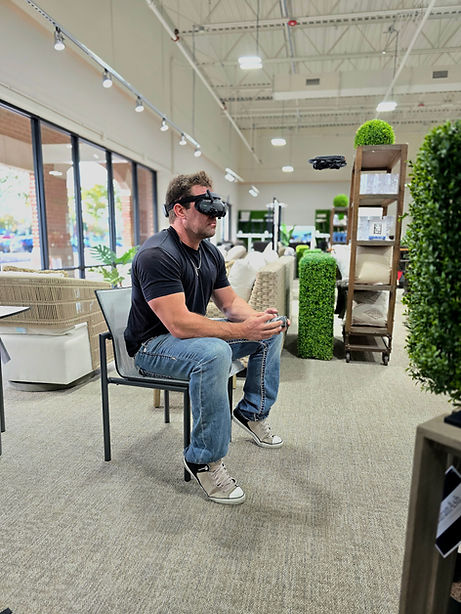

Skills Demonstration
Alongside commercial work, FPV flying is also a personal pursuit. Footage like a tower dive or a low pass through a cornfield comes from personal practice flights rather than client productions, and that distinction is worth being upfront about.
That kind of flying is where a lot of the skill behind the commercial work gets built and sharpened, the reps that make precision flying on a client set look controlled rather than risky. Freestyle flying pushes speed, proximity, and camera movement further than a commercial brief typically calls for, and that practice translates directly into better judgment and cleaner execution when the same skills are applied to a paying production.

FAA Part 107 and Safety Credentials
All FPV and standard drone operations are conducted under an FAA Part 107 remote pilot certificate. That includes understanding airspace classifications, securing authorization for controlled airspace when a shoot requires it, and following the same safety protocols on every job regardless of size.
Indoor flights, flights near people, and flights in restricted or controlled airspace all carry their own requirements, and those requirements are treated as part of the production plan rather than an afterthought. Productions that hire an FPV pilot are hiring someone who has already worked through the coordination that makes those flights legal and safe to execute.
For productions near restricted airspace, such as the O'Hare Class B airspace that covers much of the Chicago area, the necessary FAA authorization is built into pre production planning rather than something worked out on shoot day.

Recent Corporate Video Productions


The Great Escape | 9-Year Video Production Partnership
Nine-year production partnership including Product tutorials, store tours, brand messaging, how-to content, and cyclorama studio design producing 400 product shots per day, and a YouTube channel grown from 400 views to nearly 2 million, filmed and edited entirely by Jamie Link Photography.


Our Clients


